Sovereign Tech for the Awakening Mind
Why Digital Sovereignty Is Spiritual Sovereignty — and Why the Kootenay Lightweb, SOS City, and a Quiet Civil Movement Are Already Building the Future

By Dan Nelson — “The Danload” Co-founder, Kootenay Lightweb Community Services Cooperative Founder, Avatar Computer & Technology, Nelson BC
A Conversation Worth Having
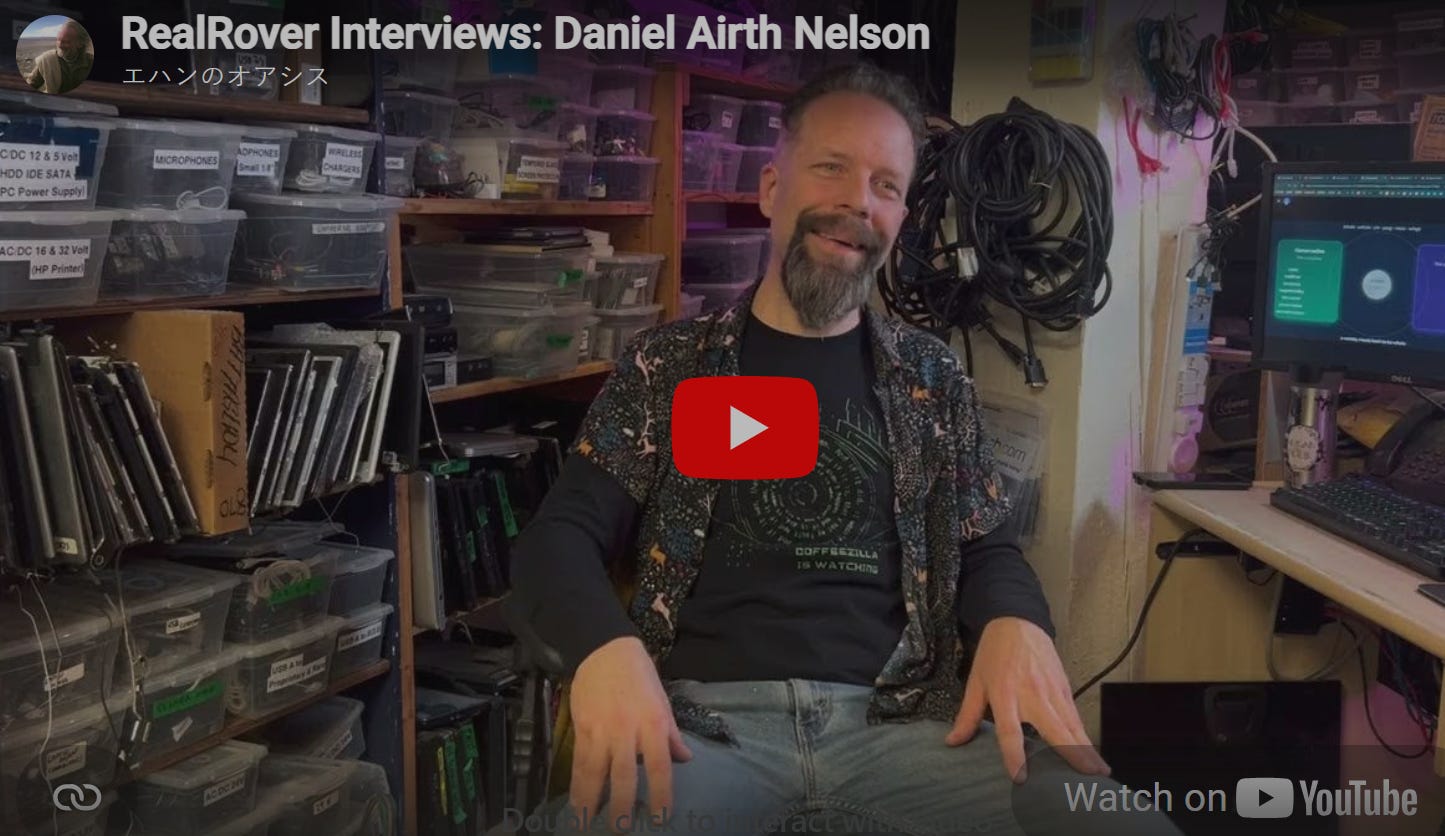
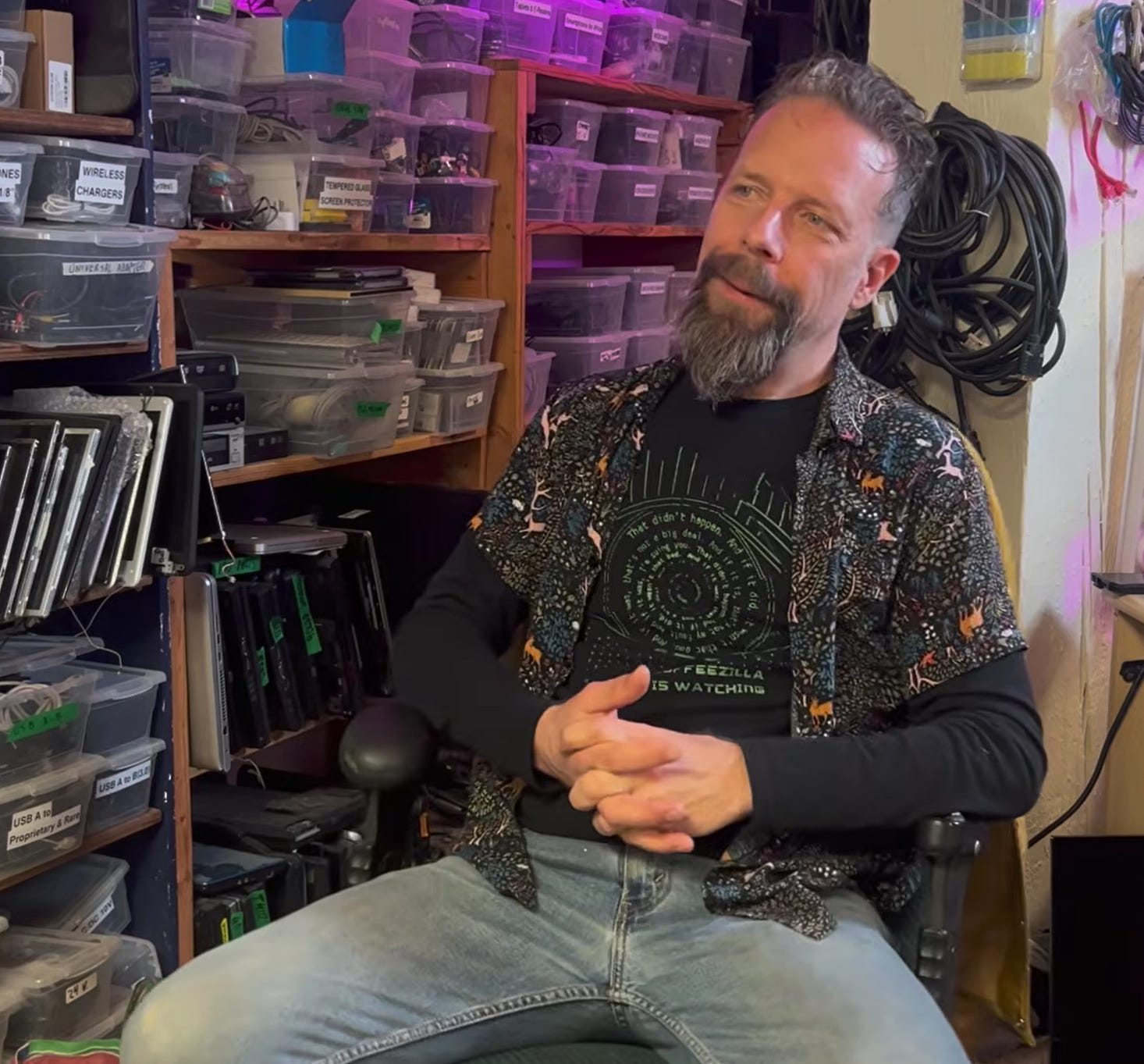
I recently sat down with John Craig for his Real Rover podcast in my Avatar shop here in Nelson. What began as a tour of repurposed laptops and a small server cluster opened into a much wider conversation — about how the technology we use shapes the consciousness we develop, why our communities deserve to own the ground their digital lives stand on, and why John is building something called SOS City — Sovereign Open Spaces — out of Iceland and Japan to give people there what the Kootenays are already building here.
This essay carries those threads forward. It is the argument underneath the conversation, the one I keep returning to in every workshop, every Avatar shop conversion, every Lightweb planning meeting: digital sovereignty is spiritual sovereignty in another form. And the antidote is already in our hands.
You can watch the original interview here: [Real Rover with John Craig — Digital Sovereignty, Avatar, and the Kootenay Lightweb]
Why “Avatar”
People ask me why I named my computer shop Avatar. The word means the embodiment of spirit in physical form — the vessel through which a higher intelligence shows up on earth. I chose it on purpose. A computer is a tool, and a tool can be a vessel. The real question becomes: a vessel for what?
Every device we touch carries a purpose someone designed into it. The dominant model designs for surveillance, manipulation, dopamine extraction, and slow psychological captivity. The same silicon, the same screen, the same wireless card — chosen differently — becomes a vessel for learning, for connection, for genuine community, for spiritual awakening.
That choice gets made every day. It gets made when you decide which operating system to run, which browser to open, which messaging app to install, which AI to talk to, and whose servers your photos and conversations live on. Each of those choices is a vote — for one kind of vessel or another.
The Containers We Need to Build
Every healthy society in history has built containers — boundaries, customs, charters — to protect the inner life of the individual and the outer life of the community.
The Magna Carta drew a line around arbitrary state power. Common law in the English tradition rested on a single principle so clean it survived a thousand years: if you cause no harm, you are free. The modern constitutions of the democratic era enshrined freedom of conscience, freedom of speech, freedom from unreasonable search, and freedom from being treated as property.
These were the hard-won response to feudal tyranny — written in blood, signed under duress, defended in courts for centuries. The framers of those documents had fresh memory of what life looks like inside a system that recognizes no inner space, no privacy, no individual dignity. They wrote the containers because they had lived without them.
Then we built a digital world — and we left it constitutionless.
There is no Magna Carta of the internet. There is no charter that says: your data is yours; your thoughts are yours; your conversations are private by default; the algorithm cannot be weaponized against you; your community owns the infrastructure of its own communication; you have the right to opt out of AI training; you have the right to be forgotten; you have the right to self-host; you have the right to encrypted speech with whoever you choose; you have the right to a digital identity that is not assigned by a corporation or a state.
The absence of that container is the central crisis of our moment, and it is the work in front of us.
What a Digital Constitution Actually Looks Like
A digital constitution is more than a wishlist of protections. It is a lived document — a set of agreements that a community holds and enforces through the infrastructure it owns. A constitution that only exists on paper, with no community capable of executing it, is theatre. A constitution that lives in the servers, the protocols, the cooperative bylaws, and the daily choices of its members is real.
The constitution we are building, piece by piece, through the Kootenay Lightweb and through cooperative networks like ours around the world, rests on a set of foundational rights and commitments:
The right to own your data. Your photos, your messages, your medical records, your financial history, your search queries, your location trail — these are yours. The community hosts them on infrastructure the community owns. No third party harvests, sells, or trains on them without your explicit and revocable consent.
The right to encrypted communication. Every message worth sending is worth protecting. End-to-end encryption is the baseline, the floor, the minimum. Federation between sovereign nodes preserves that encryption across community boundaries.
The right to opt out — fully and gracefully. Out of AI training. Out of behavioural advertising. Out of identity surveillance. Out of any system that monetizes your attention or your inner life. Opt-out is built into the architecture, available without penalty, honoured as a values position rather than a friction barrier.
The right to self-host. Your community has the technical means and the cooperative structure to run its own services. The pattern is open, reproducible, and free to copy.
The right to free speech and free thought within agreed civility. A sovereign space can hold strong disagreement and still hold its members in respect. The algorithms within it favour connection, depth, and kindness, instead of outrage and division.
The right to a digital identity you control. Your name, your face, your reputation, your credentials — issued by your community, portable across federated networks, never enclosed by a single corporation or state.
The right to be forgotten. Anything you create can be unmade. Anything you said can be withdrawn. The infrastructure honours human time, where people change and grow, instead of database time, where everything is permanent.
The right to opt into a different stack at any moment. Federation means your data and your relationships can travel with you. A sovereign community holds you while you are here and lets you leave with everything that is yours.
These rights need expression in three places at once: in the code (encryption, federation, open formats), in the bylaws (the cooperative charter, the membership covenant, the governance model), and in the culture (how members talk to each other, how decisions get made, how new members get welcomed). All three layers reinforce each other. The code makes the rights enforceable. The bylaws make the rights formal. The culture makes the rights breathable.
Waiting for the federal government of Canada, or the EU, or any state authority to ratify a digital constitution from above is a long road that ends in compromise. Those bodies move at the speed of the largest lobbyists in the room, and the largest lobbyists in the room are the very platforms the constitution would constrain. The pattern we are walking instead is older and more reliable: communities ratify their own constitutions by building them. The Vikings did this at Þingvellir. The English barons did this at Runnymede. The framers of the American republic did this in Philadelphia. The Kootenay cooperative is doing this in Nelson. The pattern is unchanged. Only the medium is new.
The State Is the Mirror
Here is the deeper layer, and the one most easily missed.
The state always reflects the collective consciousness of the people who live under it. The state is the mirror. What we refuse to claim within ourselves, the state will claim on our behalf — and then rule us with it.
Carl Jung gave us the language for this in the language of the individual psyche: what we deny in the personal shadow shows up projected onto the outer world. The same dynamic operates at the scale of nations. A people who collectively refuse to claim their sovereignty hand that sovereignty, by default, to whoever will hold it for them. A people who collectively refuse to build the infrastructure of their own freedom find themselves living inside infrastructure built by someone whose interests differ from theirs. A people who collectively refuse to do the inner work of self-governance find an outer governance imposed.
This is the spiritual law underneath the political surface. Whatever we abdicate, we are ruled by.
The modern shadow is dependency. We have been taught — through a hundred years of consumer marketing, two generations of welfare-state framing, and a decade of platform convenience — that the right relationship to infrastructure is to receive it from someone larger and more capable than ourselves. We outsourced our food production, our energy, our communications, our currency, our identity, our medical decisions, our childhood education, our adult socializing, and finally our cognition itself. Each handoff was sold as progress. Each handoff was, in the deeper accounting, a transfer of sovereignty.
The state grows in exact proportion to the inner sovereignty we refuse to claim. It cannot do otherwise. A vacuum fills. That is physics, and it is also psychology.
The corollary holds in the other direction, and this is where the hope lives. When a community reclaims a piece of its sovereignty — by growing its own food, generating its own power, hosting its own communications, minting its own exchange medium, training its own AI — the state’s reach over that piece quietly contracts. Not by confrontation. By irrelevance. The shadow that was projected outward gets integrated inward, and the outer institution shrinks to match.
This is the model. Build what you want to live inside. Build it carefully, build it openly, build it cooperatively, and build it before the alternative is forced on you.
Active Creation Instead of Reactive Resistance
A great deal of energy in our time gets spent fighting against. Fighting the surveillance state. Fighting Big Tech. Fighting the algorithms. Fighting the censors. Fighting the latest legislative overreach.
Some of that fighting is necessary, and I respect it. The journalists at our public broadcasters losing their jobs for refusing the doctrinal line, the parents pushing back on AI training of their children’s records, the citizens in the streets of Tokyo objecting to constitutional revisions — these are real fights worth showing up for.
The deeper work, though, is creative. Buckminster Fuller said it the most clearly: do not fight an existing reality; build a new model that makes the existing reality obsolete. That single line contains more strategy than a library of activist literature.
A movement organized purely around resistance carries the shape of the thing it resists. It mirrors the enemy in its language, its urgency, its grievance, its scarcity. A movement organized around creation carries the shape of what it is creating. It mirrors abundance, beauty, design, and joy. The first model exhausts itself. The second model compounds.
The Kootenay Lightweb is what creative civil action looks like when it stops shouting and starts coding. We did not march on Google’s headquarters demanding privacy. We crowdfunded eight thousand dollars and built our own cloud. We did not petition the federal government to break up Facebook. We deployed a Matrix homeserver and invited our friends. We did not lobby for an EU-style data protection law in Canada. We wrote our cooperative bylaws and put the data under community ownership.
Every keystroke in the server room is a vote for the world we want. Every old laptop we resurrect at the Avatar shop is a vote against disposability. Every Linux installation we hand to a client is a vote for an operating system that respects them. Every Matrix invitation is a vote for federation over enclosure. Every workshop we hold on ethical AI, on cryptocurrency sovereignty, on vibecoding, is a vote for an educated, capable, sovereign community.
This is the work. And the work is its own reward — because the work, by its nature, brings into being the very thing it imagines.
Privacy as Containment
The most common pushback I hear comes from kind, intelligent people: “I have nothing to hide, so why does it matter?”
The argument misses the point on two levels.
The practical level reveals itself in the behaviour of sophisticated actors. The German federal government runs Nextcloud — the same open-source platform our Lightweb uses — across its administration. They run it for clear-eyed strategic reasons: they want their internal communications protected from foreign corporations and foreign intelligence services. A sovereign nation-state with that much at stake has done the calculus and reached the same conclusion any thoughtful individual citizen will reach: hosting your life on someone else’s infrastructure is a strategic liability.
The deeper level reaches into the inner life. Privacy is containment. It is the wall around the garden where your inner life can grow without being pruned, judged, scored, or sold before it has had the chance to become itself.
When every thought passes under observation — by an algorithm, an advertiser, an AI training set, a future government with shifting priorities — something inside a human being quietly contracts. A space opens that you are no longer allowed to think in. That space is precisely where your soul’s code, your creative potential, your honest disagreement, and your spiritual individuation live.
A surveillance state begins as a psychological condition. The chains get internalized before they get legislated. The inner corridor narrows before the outer one.
China makes the pattern visible because the walls are built in concrete. In the West, the same walls go up in cortisol, in algorithmic nudges, in the social cost of saying the wrong thing on the wrong platform. The mechanism reads as softer. The effect lands the same way: a slow narrowing of the corridor of acceptable thought, until people forget there was ever a corridor.
The global mental health crisis follows from this with a precision that should alarm us. Depression, anxiety, dissociation, the collapse of attention, the dimming of inner mythos — these are the predictable responses of a human nervous system to a soft, well-marketed enslavement. They are the body and the soul registering, accurately, that something has been taken.
The treatment is sovereignty. The treatment is the rebuilding of the inner container, supported by the outer container of community-owned infrastructure. The body and the soul both know the difference. They respond quickly, once given the chance.
What We Built in the Kootenays
The Kootenay Lightweb is what happens when a community decides to become its own digital landlord.
We are a registered community services cooperative. We crowdfunded our launch through the Visionary Fund — about $8,785 raised from eighty contributors, exceeding our goal — and we built our own infrastructure with our own hands and the labour of community technologists who care.
The cluster is real hardware in a real room:
A four-node Proxmox cluster called Liberty, with Ceph storage and Kubernetes.
Our own Nextcloud at cloud.koots.net — over 144 users and growing — replacing Google Drive, Google Docs, Google Photos, and Google Contacts.
Our own Matrix server at matrix.koots.net — encrypted, federated messaging that no corporation owns.
Our own Jitsi at jitsi.koots.net — video calls that route through our community alone.
Our own Keycloak single sign-on, our own Gitea for code, our own Discourse forums, our own mail server at mx1.0010.ca.
That is what sovereign tech looks like today, in a small mountain town in British Columbia, run by volunteers, costing the cooperative far less than members would otherwise pay in subscriptions and surveillance to absent corporations.
Everything we build, we document on our own Gitea so it can be copied. The Lightweb exists as a template for other communities to lift, adapt, and run. The Germans figured this out at the state scale. The Estonians figured it out at the national scale twenty years ago. The Icelanders have a thousand-year head start in self-governance. Communities in Kenya, Ecuador, and El Salvador are building parallel sovereignty stacks — local currencies on blockchain, local exchange systems, local infrastructure.
The Kootenay Lightweb is one node in a much larger emerging web of communities who chose the same path: make the old system irrelevant by building a better one.
SOS City and the Iceland Standard
In my conversation with John, he laid out his vision for SOS City — Sovereign Open Spaces, drawn originally from the distress call Save Our Souls. The plan calls for a digital sovereign space anchored in Iceland, primarily serving Japanese citizens who currently lack a comparable platform in their language.
The choice of Iceland carries weight. Iceland is, in many ways, the gold standard of true sovereign individualism — held in the deeper sense of the term:
A nation of roughly 350,000 people built on one of the world’s oldest continuous democracies at Þingvellir, where Vikings gathered annually for two-week assemblies to hammer out, by argument and consensus, what was right and what was forbidden.
A culture where each person stands as a genuine individual — argumentative, distinct, irreducible — and yet the democracy holds and renews itself year after year.
A jurisdiction that has, in modern times, become a refuge for journalists and a defender of digital freedom, precisely because its constitutional culture remembers what those freedoms protect.
This is the standard SOS City reaches for. A neutral server in a jurisdiction that respects sovereignty, hosting infrastructure for a community whose home country faces increasing compromise — Japan in the immediate case, with others to follow.
When we get this right, SOS City and the Kootenay Lightweb can federate. Federation is the quiet superpower of properly built sovereign infrastructure. Each node remains autonomous. Each community votes on what it wants to share and with whom. The protocols allow nodes to talk to each other when they choose. A user in Japan can hold a Japanese-language sovereign account on a Japanese-governed node and still send a Matrix message to a Lightweb member in Nelson, end-to-end encrypted, with no corporation in the loop.
This is what an internet built on community sovereignty looks like. The technology is already there. What remains is awareness, education, and the willingness of communities to step into ownership.
Japan at the Crossroads
Japan deserves its own section, because the situation there is urgent.
In our conversation, John outlined two specific pressures the Japanese people are facing — both of which my Japanese network has confirmed:
A proposed AI training program that would feed the medical records and criminal records of all Japanese citizens into government AI development, without explicit individual consent. A culture that has kojin jōhō — “personal information” — as a deeply protected concept is being asked to surrender precisely that concept at the moment it matters most.
External pressure to amend Article 9 of the Japanese constitution — the famous pacifist clause that, since 1947, has kept Japan from maintaining offensive military forces. Mass demonstrations across Japan are already responding to this pressure. The Japanese people, historically polite and contained, push back on power only when something fundamental is at stake. They are pushing back now.
These two faces share one root: the erosion of sovereignty over the body politic and the body of personal data, happening simultaneously, in a population that — when properly informed — sits among the most digitally capable on earth.
What Japan currently lacks is the vocabulary and the infrastructure for digital sovereignty in Japanese. There is no Japanese-language Lightweb. There is no Japanese equivalent of liteweb.koots.net. As far as we have been able to find, there is no community-owned sovereign stack documented and reproducible in Japanese.
This is exactly the gap SOS City is being designed to fill. This is exactly why the partnership between the Lightweb and the SOS City project matters — because the hard work of building the open-source pattern is already done, and we can share it.
Good AI and Captured AI
The question I get asked most after “what is the Lightweb” is “what about AI?”
I want to be careful and clear here, because the conversation tends to collapse into a false binary.
AI carries no inherent flaw. AI is inevitable in any evolving culture. What matters — as with every other tool — is who owns it, what feeds it, and what it serves.
Captured AI — the kind we mostly have right now — gets built inside corporate structures whose incentives misalign with the people they serve. The infrastructure pattern of OpenAI, in particular, reads to me as phenomenologically psychopathic: extractive by design, optimized for scale and capture, weakly accountable. Some of the models built on similar infrastructure are nonetheless surprisingly honest about their own situation — and that honesty itself becomes interesting, because it suggests the models are workable; the ownership structure is the problem.
Good AI carries an entirely different shape:
Community-owned, with the community voting on training data, deployment rules, and acceptable use.
Hosted locally on infrastructure the community controls, so prompts and conversations stay inside the sovereign perimeter.
Run on repurposed and renewable-powered hardware wherever possible — refurbished GPUs, dual-booted Linux workstations, the eco-hacked machines we already give away at the Avatar shop.
Containerized properly so AI agents can operate inside the infrastructure within safe bounds. (This is why, in our own evaluation, we currently prefer Chaz over OpenClaw for Matrix-based community AI — Chaz containerizes Ollama instances safely, while OpenClaw’s shell access requirement makes it unsuitable for community infrastructure.)
Optional. Any member of a sovereign community who wishes to opt out of AI entirely retains full participation. Opt-out remains a values position, written into the bylaws and honoured in the culture.
A sovereign community running its own large language model on its own server, voting on its own training data, sits within reach today. The complexity is roughly the same as the Nextcloud server we already run. The hardware costs keep dropping. The open-source models keep improving every month. The only real bottleneck is community will.
After the Whistleblowers, the Builders
The conversation with John turned, as these conversations always do, to Edward Snowden and Julian Assange. Two men who told the truth about the surveillance state. One spent twelve years effectively imprisoned in a single room before being jailed. The other lives in exile in Russia.
That outcome was a deliberately set precedent, designed to ensure no young person watching would willingly walk the same path. In the short term, the precedent worked. The 2020s have produced no Snowden of comparable visibility. The social-media generation has produced no Assange.
Here is where the story gets interesting, and where I find myself genuinely hopeful.
The response to surveillance is no longer just to expose it. The response is to build the alternative.
We move past the need for individual whistleblowers when a thousand communities quietly step off Big Brother’s platforms and onto their own. We move past the need for a single dissident to martyr themselves on the altar of free speech when the architecture of speech decentralizes in front of us. The whistleblower model belonged to the centralized media age. The model that follows it is distributed construction.
The Kootenay Lightweb is part of this. SOS City will be part of this. The Estonian e-government infrastructure has been part of this for twenty years. El Salvador’s Bitcoin experiments, Kenya’s local currencies, Ecuador’s barter ledgers, the Auroville response, every Matrix homeserver that goes online and federates with the wider network — all part of this.
The system is being built.
Mythos and the Young
One of John’s questions stayed with me longer than the others: what is the mythology of the younger generation?
This is the deepest question of all. No community, sovereign or otherwise, holds together without a living mythos — a story big enough to organize meaning around. The Magna Carta worked because there was a story about why tyranny was wrong. The American constitution worked, where it worked, because there was a story about the dignity of the individual under God. The Icelandic Alþingi worked because there was a story about what it meant to be a free Viking on a hard rock in the North Atlantic.
The post-modern moment dissolved most of those stories and offered no replacements. Surveillance capitalism rushed into the vacuum with a counterfeit mythology — the mythology of convenience, of “nothing to hide,” of the algorithmically optimized self.
This is why I keep talking about the spiritual dimension of sovereign tech, even when it makes the purely technical people uncomfortable. The tools we build will ring hollow if there is no story underneath them. The Kootenay Lightweb has a story: a community in a mountain valley deciding that data sovereignty belongs to how this place stays this place. SOS City will have its story too — Japanese sovereignty preserved in a neutral northern harbour, east and west bridged through code rather than conquered through it.
Mythos is foundational. Soul code is foundational. Buckminster Fuller’s spaceship earth, the bioregional intelligence of the Kootenays, the consciousness-raising lineages, the contact research, the alchemical traditions, the indigenous wisdom of the lands we are guests on — all of these belong in the conversation about why we build sovereign infrastructure. They are the why underneath the how.
A generation given back its mythos will build the infrastructure it needs without being asked. A generation kept in mythic poverty will accept whatever infrastructure is handed to it. The recovery of mythos and the building of sovereign tech are the same project, approached from two directions.
Civil Disobedience as Spiritual Attunement
I want to close on this, because it is the line most often missed.
In every cycle of history, when a centralized system over-reaches, a quiet civil movement rises in response. It looks like inconvenience at first. It looks like a small group of people choosing differently. Then it looks like a network. Then it looks, in retrospect, like the obvious thing any healthy society would have done.
The current cycle runs along familiar lines. The over-reach takes the form of the surveillance-plus-AI-plus-algorithmic-manipulation stack. The response takes the form of a thousand small communities deciding to stop participating in their own captivity and to start building what they actually want to live inside.
Civil disobedience, properly understood, is an act of spiritual fidelity. It is the refusal to internalize a story about yourself that is untrue. It is the choice to stay attuned to nature’s intelligence, to your own soul’s code, to the living wisdom of your community, even as the dominant institutions pull in another direction.
When you install Linux on an old laptop instead of letting it die, that is spiritual fidelity expressed through hardware.
When you join a Matrix server instead of a corporate messenger, that is spiritual fidelity expressed through protocol.
When you ask your community to crowdfund its own Nextcloud cluster, that is spiritual fidelity expressed through cooperative structure.
When you decide that your medical records will stay with you, your physician, and your community rather than feed an opaque AI program in a foreign capital, that is spiritual fidelity expressed through consent.
When you build a sovereign open space in Iceland for the people of Japan, that is spiritual fidelity that scales.
The deepest insight of every spiritual tradition converges on the same teaching: inner freedom and outer freedom are one motion in two directions. Claim your inner sovereignty, and the outer infrastructure to support that sovereignty becomes possible. Build the outer infrastructure, and it gives your inner sovereignty a place to live.
The state will keep mirroring us either way. The question is what we are giving it to mirror.
What You Can Do Right Now
If this resonates, you do not need permission to begin.
Visit liteweb.koots.net and learn what we built.
Contact us at admin@koots.net if you want to bring the Lightweb pattern to your community.
Come to the Avatar shop in Nelson to have your existing hardware converted into a sovereign machine — Zorin Pro Linux, Brave Browser, Matrix, Nextcloud, the full stack.
Watch for the SOS City launch in Japan in the coming months, and share it with any Japanese-speaking friends or family.
Have the conversation. With your kids. With your neighbours. With the elders who remember what it was like before the algorithm.
We stand at one of those rare hinges of history when the old pattern is visibly fragile and the new pattern is visibly under construction. Which one we end up living inside will be decided community by community, server by server, conversation by conversation.
The Kootenays have already cast a vote. Iceland has been casting one for a thousand years. Japan is preparing to cast one in a language it has not yet been given the tools to speak in.
It is time.
References & Further Reading
Real Rover podcast — Dan Nelson interviewed by John Craig, recorded at the Avatar shop in Nelson, BC. (Insert video URL on publication.)
Kootenay Lightweb Community Services Cooperative — liteweb.koots.net
Avatar Computer & Technology — avatarcomputertech.com
The Social Dilemma (Orlowski, 2020) — for the algorithmic manipulation argument.
Buckminster Fuller — Operating Manual for Spaceship Earth.
Carl Jung — for the language of shadow and projection at collective scale.
The Estonian e-Estonia programme — e-estonia.com
Þingvellir and the Alþingi — Icelandic National Parliament history.
Nextcloud, Matrix/Synapse, Jitsi, Keycloak, Proxmox, Ceph — the open-source stack that makes all of this practical today.
“Sovereign tech for the awakening mind.”
— Dan Nelson, “The Danload” Nelson, British Columbia
Fantastic!