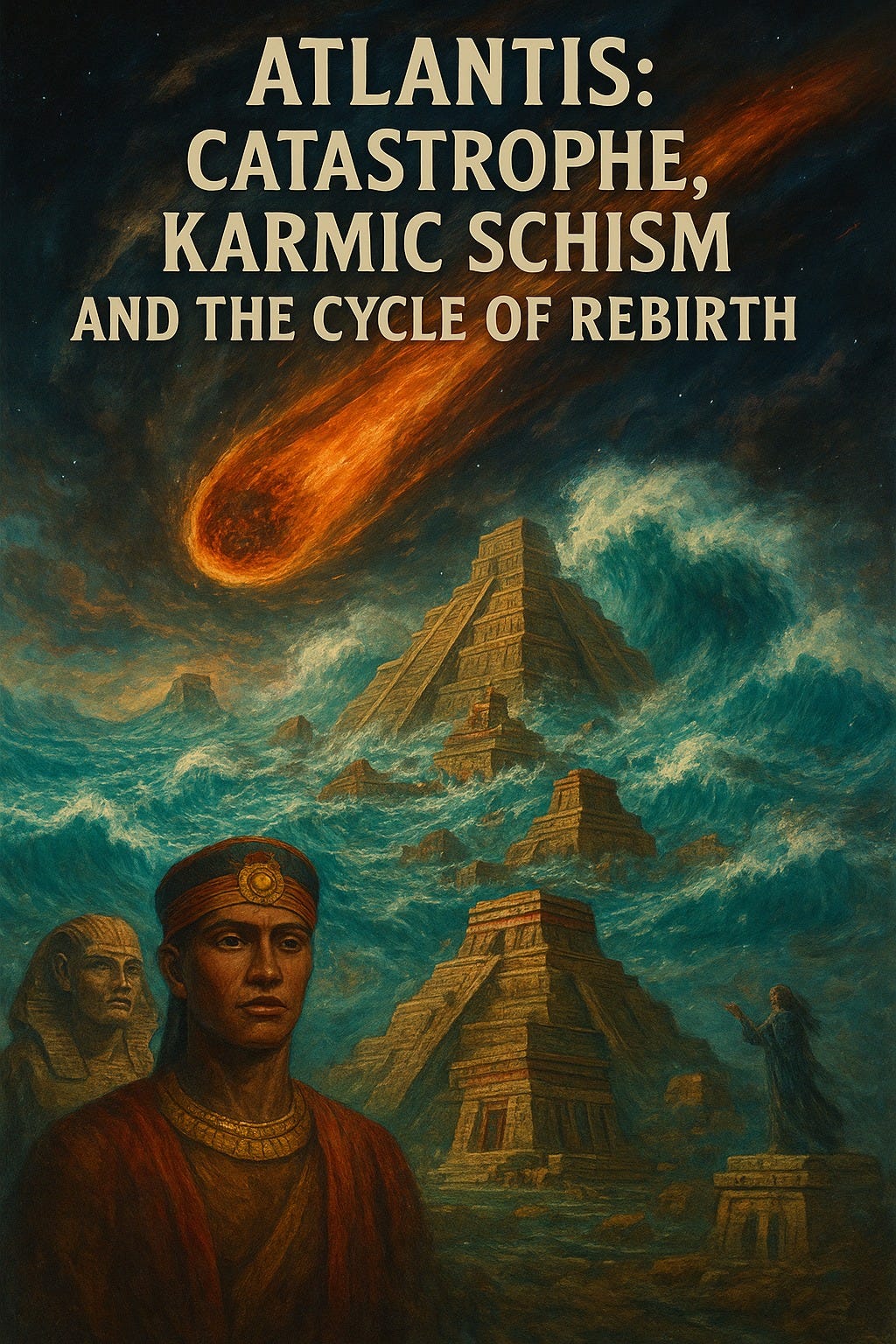
Atlantis: Catastrophe, Karmic Schism, and the Cycle of Rebirth

This is a summary of what I have gathered about the Atlantis story as I know it up to now, drawing from insights by Bashar (via Darryl Anka), Matías De Stefano, extensive viewing of Randall Carlson and Graham Hancock's lectures and writings, the old six-part documentary series The Legend of Atlantis from the 1990s, and studies of Earth catastrophe researchers on the Internet.
Approximately 12,800 years ago, a massive master comet entered our solar system and became trapped in an eccentric orbit that intersected Earth's path twice annually. As it fragmented over more than two decades, it unleashed catastrophic bombardments of cometary remnants, energized particles and debris, onto the North American and Atlantic regions, escalating from initial impacts on ice shelves to devastating tsunamis and floods.
This celestial harbinger, whose remnants still manifest as the Taurid meteor showers around late October to early November, not only signaled impending doom but directly precipitated the cataclysmic end of Atlantis, a global civilization and empire, not confined to a single location, but spanning continents with identifiable outposts and cities worldwide, including one potentially at the “Richat Structure” in Mauritania, Africa, commonly referred to as the Eye of the Sahara, as theorized and extensively discussed by researcher Jimmy Corsetti (of Bright Insight) based on its concentric rings matching Plato's descriptions, though this remains a debated hypothesis among scholars with geological evidence suggesting it's a natural eroded dome rather than man-made.
This event marked the onset of the Younger Dryas period and inspired ancient legends of comets as omens of destruction, dragons in the sky, and even the biblical flood of Noah. The anniversary of this final obliteration aligns with modern Halloween and All Souls' Day, serving as a veiled remembrance of Atlantis's fall.
Summary of the Atlantis Story
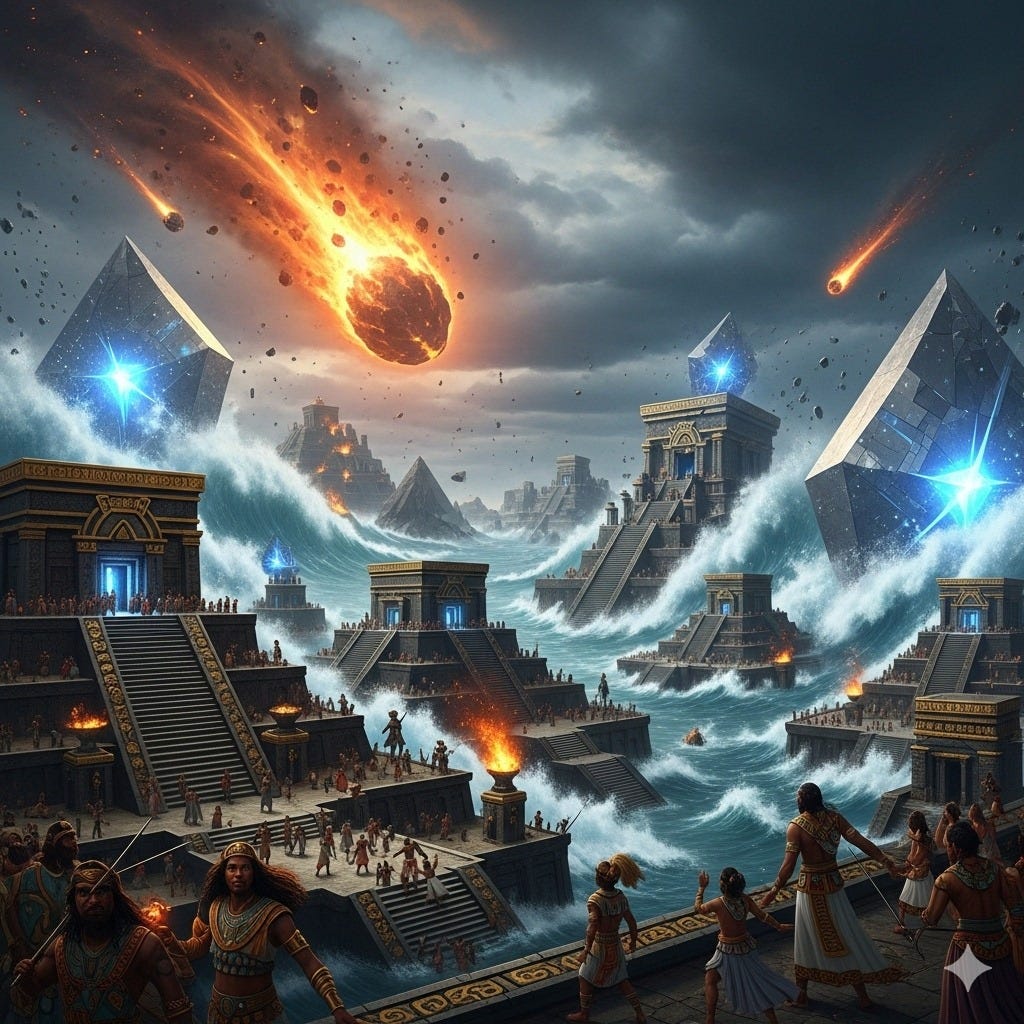
The civilization of Atlantis emerged thousands of years before its destruction, originating from indigenous migrations across North and South America from west to east. These peoples established a colony on expansive islands now reduced to remnants like the Bahamas and Cuba, during an era when massive northern ice shelves locked away vast amounts of water, lowering global sea levels by 250-300 feet and exposing more land. Atlantis expanded into a vast empire, influencing regions in North, Central, and South America, as well as Europe (particularly the Mediterranean), and northern and western Africa. Contrary to popular misconceptions influenced by Greek retellings via Egyptian stories, Atlantean architecture resembled Aztec styles,featuring large stone blocks and stepped pyramids, rather than Grecian designs. The closest surviving examples include Aztec remnants in the Americas and Minoan structures like the Temple of Knossos on Crete, an ancient Atlantean outpost known as the Labyrinth Temple. This site, dedicated to bull worship (a hallmark of Atlantean culture), included initiation rituals involving crystal meditations along stone-lined paths painted in red, black, and white, symbolizing cosmic enlightenment.
Atlantean society was advanced and harmonious in its prime, with brown-skinned inhabitants deeply connected to nature, the stars, and the Earth. They excelled in astronomy, mathematics, herbal healing, and vibrational technologies, using massive shining crystals for light, power, long-distance communication, and even resonating with the cosmos. Urban life featured grand pyramidal temples painted in red, white, and black, sometimes sheathed in gold, silver, or the alloy orichalcum (a mix of copper, gold, and silver). Paved stone streets bustled with people, while lighter-than-air balloons floated overhead. They communed with marine life, particularly dolphins and whales, which swam into temple pools via canals for shared rituals, fostering a symbiotic society of land and sea. Education and spiritual practices involved drumbeats synchronized to heart rhythms, inducing meditative states for effortless learning and retention.
Over eons, however, Atlantis fractured into two factions: the "children of light," who preserved ancient ways of harmony with nature, and the "children of darkness," corrupted by fear-based beliefs and illusions of power. As the master comet's orbit brought biannual bombardments, initially targeting ice shelves and the eastern Americas, causing tsunamis, many foresaw the end by tracking its trajectory. Forewarned Atlanteans, especially the enlightened ones, migrated to safer havens like South and Central America, Africa, Europe, and the nascent Egyptian culture, carrying their knowledge of pyramid-building, technology, and architecture. They preserved libraries and records in hidden sites, such as under the Sphinx in Giza, in Alexandria, the Yucatan, Peru, and South America, many still undiscovered today.
The final days culminated in apocalypse: a primary cometary body pierced the atmosphere, striking the Atlantic Ocean and carving a crater in the seafloor. This unleashed 300-foot tsunamis that obliterated Atlantean islands and coastal settlements across the Americas, Europe, Africa, and the Mediterranean. The impacts melted ice shelves, triggering massive floods and runoff that raised sea levels, submerging most remnants of the civilization and explaining the scarcity of archaeological evidence today. Some inhabitants, either in denial, corrupted, or unwilling to abandon their homeland, perished, while others embraced reincarnation to revisit these cycles in future eras.
The narrative frames Atlantis's fall as a cautionary cycle, with the Americas, its original migratory cradle, poised for a rebirth. Indigenous tribes in North, Central, and South America hold preserved knowledge of this resurgence, urging a return to nature's harmony, gratitude, and creativity. The message calls for individuals to internally revive Atlantean ideals through spiritual connection, drum-induced meditation, and appreciation of the Earth, allowing a new, positive Atlantis to emerge not from ruins but from human hearts and societies, transforming the end times into beginnings of glory, beauty, and peace.
The Morals, Metaphysical Fall, and Karmic Lessons of Atlantis
Atlantis embodied profound moral and metaphysical principles in its prime, rooted in harmony with nature, interconnectedness, and inner development rather than external conquest. Society emphasized balance, viewing life through natural cycles, birth, growth, decay, and rebirth, like seasons or the blossoming and withering of flowers. This fostered a lack of fear toward death, as Atlanteans understood reincarnation and the eternal nature of existence, reducing the drive for survival-based dominance.
Morally, they prioritized community over blood ties, with clans organized by elemental affinities (e.g., water, fire, air, earth) that guided relationships, sacred unions, and spiritual growth. Sexuality was seen as a tool for energy exchange and manifestation of spirit into matter, free from shame, with sacred practices aligning chakras for soul evolution rather than mere pleasure. Education and rituals, such as drum-induced meditative states, promoted effortless absorption of knowledge, while interactions with dolphins, whales, and the environment reflected a symbiotic "land and sea" society. The core ethic was one of gratitude, grace, and creativity, with bull worship and crystal-based initiations symbolizing cosmic enlightenment and unity.
Metaphysically, Atlantis "fell" due to a profound internal schism and disconnection from these principles. Initially focused on inward expansion, understanding dimensions, vibrations, and the cosmos, society fragmented into the "children of light" (those maintaining Earth-star connections and harmony) and the "children of darkness" (those succumbing to fear-based beliefs, corruption, and the illusion of power). As awareness of their civilization's impending end grew from observing cosmic cycles (including the approaching comet), disagreements arose among layers of governance: high priests advocated accepting death and rebirth in future cycles; kings and families sought to preserve knowledge through migration and cultural sharing; the military pushed for forceful control to impose these views.
This led to the misuse of advanced technologies, like pyramids, originally for bridging dimensions and preserving memory, but repurposed for domination and conquest. The metaphysical root was a shift from inner wisdom to outer manifestation driven by fear of oblivion, severing the sacred union of spirit and matter. This distortion, confusing spiritual purpose with survival needs, disrupted the kundalini-like flow of energy, trapping higher consciousness in base impulses (e.g., genitals symbolizing unchanneled creation). Matías De Stefano describes this as a "trauma" echoing modern issues, where disconnection from nature's cycles (e.g., seasons, death-rebirth) fueled ego-driven empire-building, mirroring how post-Atlantean societies like Egypt (Chem) retained some wisdom but lost the full harmony.
Karmically, the catastrophe, a comet's orbit causing biannual bombardments, culminating in massive tsunamis and the Younger Dryas, was not mere chance but a manifestation of collective imbalance. The karmic setup stemmed from Atlantis's failure to maintain unity, allowing fear and power illusions to dominate, creating a "recycling" of patterns for future resolution. This is as an opportunity for growth: Atlanteans who perished or migrated carried souls into reincarnations, preserving knowledge in sites like Giza or the Yucatan for rediscovery.
The split between light and darkness karmically replays in modern times, especially in the Americas, offering a chance to choose harmony over corruption. Matías notes in the podcasts that this echoes broader cosmic lessons from other star systems (e.g., grays as "bad guys" due to over-technological disconnection, or interdimensional beings aiding evolution without interference). The great flood-like event served as a karmic reset, submerging remnants to force inward reflection, urging humanity to reconnect with cycles, release traumas (e.g., religious shame around sexuality), and build networks of love rather than empires. Ultimately, Atlantis's fall teaches that true power lies in surrendering to natural rhythms, fostering community, and transcending fear, lessons to prevent repeating the cycle in our era of rapid global awakening.